
What Kind of Editing Do I Need?
Developmental Editing · Line Editing · Light Editing
Developmental Editing
Developmental editing, also called substantive editing or in-depth editing, is appropriate if you are in the beginning stages of writing a book or if you have a partially written manuscript and want assistance moving forward. Developmental editing is also useful if you need to substantially “book-doctor” or revise a full-length manuscript.
Developmental editing begins with a conversation over the phone, Zoom, or in person to discuss your vision and goals for the book. I listen carefully, ask questions, offer suggestions, and collaboratively brainstorm how you might get from A to Z, or maybe Y.
Usually I work with you for the time it takes to complete the writing project. I too want the best for your book and to do so I consistently draw upon my life-time of heavy reading, my decades of editing, my training and experience as a writer, and my instincts. Below are some of the issues that I most often address.
- What is the book’s core premise and why does it matter?
- How will your book build upon, extend, or disrupt what other authors have previously published?
- Who are your readers?
- How can you structure your content to communicate persuasively to readers?
- Should you use narrative examples to illustrate abstract ideas and if so, which examples will be most relevant and how to weave them into the text?
- Is your material coherent? Relevant? Fresh? Readable?
- What content belongs in an introduction? A conclusion?
- Does your text have a satisfying beginning, middle, and end?
- How will you fully and clearly develop your ideas?
Outlining or mapping your material plays a crucial role. If done in advance, this kind of planning can often, but not always, save a lot of headaches later on in the process. Other times, a developmental edit will entail dismantling an existing structure and building a new one. Most published books go through at least one round of developmental editing.
To a lesser or greater extent, developmental editing includes line editing. (See below)
“With a rare blend of artistic vision and purposeful execution, Karen helped me to become a more effective truth teller.”
— Maureen Walker, When Getting Along Is Not Enough
“Of the many people who contributed to getting this book into its final shape, Karen Propp is by far the most important. I am deeply grateful to have been able to work with her on this project. Without her perceptive questions, insights, ideas, stories, and well-honed skills as a writer and editor, this book would never have been finished.”
— Amy Edmondson, The Fearless Organization
“I am grateful to Karen Propp for her outstanding editorial support every step of the way. I couldn’t have asked for a more patient and skilled partner.”
— Tsedal Neeley, Harvard Business School. The Language of Global Success
Line Editing
Also called close editing, or copy editing, is the detailed editorial work that I do on a text to make your prose clear, concise, and readable. All good writing is rewriting, to paraphrase Truman Capote, Roald Dahl, Ernest Hemingway, and others.
I use the track changes function to tighten language and clarify meaning. I focus on the flow of ideas, transitions, tone, word choice, and style. I cut redundancies and suggest expansions. I address issues of grammar, punctuation, usage, consistency, and clarity. I comment on unclear ideas, query items that need your attention, highlight passages that still need work, and reformat the occasional bulleted list or confusing font.
The beauty of track changes is that you can go through each of the suggested changes and choose whether to accept or reject as you make additional revisions. When circumstances warrant, I still have some red pencils on hand to edit directly on paper manuscripts.
"Karen is an excellent reader of work-in-progress. Her eye and ear and heart are 100% accurate; her feedback is extremely clear, terrifically insightful, and refreshingly candid."
— Joan Leegant, Wherever You Go and An Hour in Paradise
Light Editing
Light editing is a lite version of line editing (See above) and is appropriate for your polished manuscript. This is when I take out my highest magnitude lens and search out stray phrases, awkward idioms, and the occasional obfuscation. I also offer opinions on aspects of the manuscript that I think could still be improved.
Line editing is not to be confused with proofreading. As the final step before your manuscript goes to the printer, a proofreader will check the surface type for errors.
"Wonderful editorial support was given me by Karen Propp..."
— Michael Beer, Harvard Business School
Let's Collaborate!
Much of my collaborative work is helping scholars and other experts communicate complex ideas to readers beyond their own disciplines. Some authors come to me with years of research but no clear structure for a book. Others have a compelling idea but are still discovering the book they want to write. Still others have a manuscript that needs to be reimagined rather than simply revised.
My role in these projects extends beyond editing. I become a collaborator—asking questions, testing assumptions, shaping arguments, developing narrative, and helping authors transform expertise into books that engage and persuade readers.
The Story Inside the Idea
My sweet spot is helping authors transform abstract ideas into engaging stories. I believe readers can understand ideas most deeply and clearly when they encounter them through narrative.
Experts often know exactly what they want to explain but struggle to find the narrative, vignette, or illustrative example that allows readers to more immediately grasp its significance. Together we identify moments from research, professional experience, interviews, history, popular culture, or everyday life that illuminate larger ideas without oversimplifying them.
Book Proposals
Over the years, I have collaborated on proposals that have secured literary representation and publication with major publishers. A successful proposal is both a sales document and the intellectual and structural blueprint for the book itself. The strongest proposals clarify the central idea, identify the audience, demonstrate the market, and show publishers not only what the book will say but how it will unfold chapter by chapter.
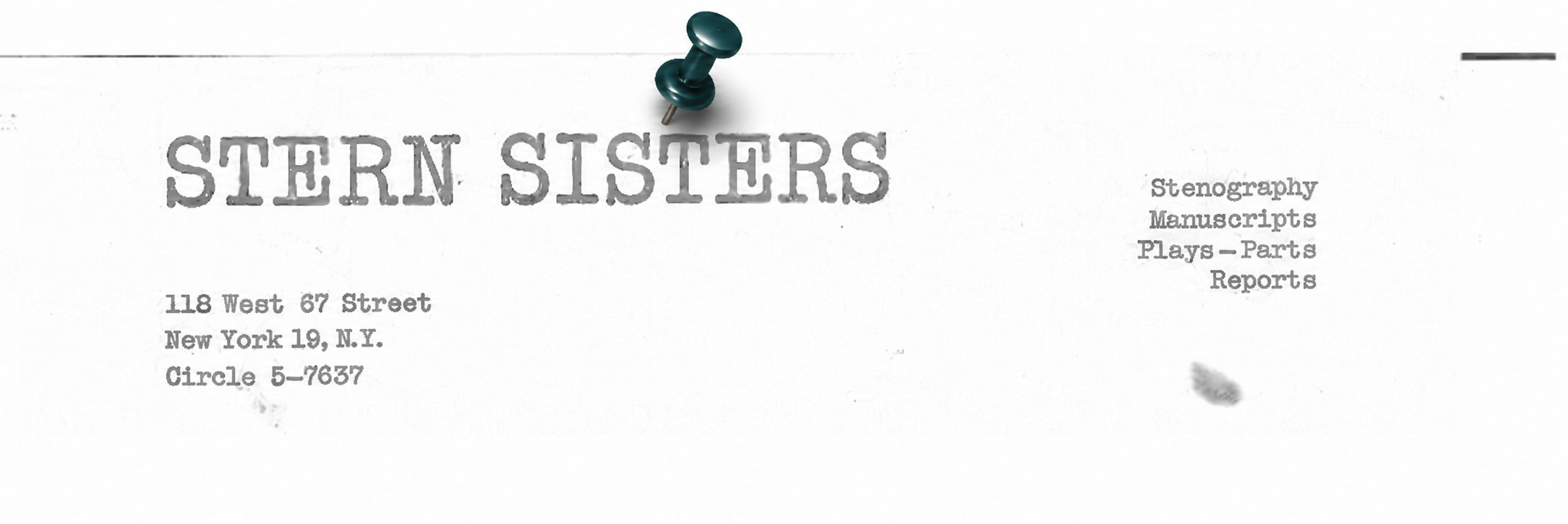
Above my desk hangs a piece of stationery that belonged to my grandmother and her sisters, who had a typing, editing, and stenography business in the lobby of the Great Northern Hotel. Rat-a-tat ding! I see them now: Henrietta, Rose, and Helen, high-speed typists, sitting with perfect posture at small metal desks. At lunch time, they reapply their lipstick, then talk at once on their fast walk to the Automat. Their file cabinet is overflowing with carbon copy from publishers, writers, musicians. I feel them nearby when I sit with someone else’s pages—listening for what they mean, sensing where the language tightens or wanders. The scrap of paper reminds me that I come from people who understood that words are a form of labor and care.