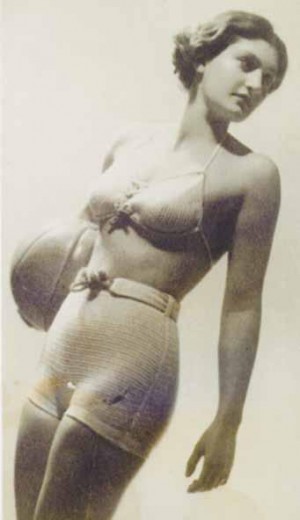
People speak of love at first sight. What happened to me one November evening in a darkened Boston theater was closer to a summons. My mother and I were there to screen the documentary, Watermarks, a film about the Hakoah Vienna women’s swim team in the 1930s. The now elderly but still vigorous women swimmers spoke of their idyllic Viennese girlhoods in an accented English – stern but affectionate, lilting but precise—I had heard only from my grandparents and elderly Austrian relatives. Their accents summoned me, as did my mother’s eyes, which were tear filled when the lights came on.
The film’s director, Yaron Zilberman, led a discussion after the screening, and when it ended, I rushed forward to tell him that I was going to write a novel for young people about the swimmers’ decision to boycott the 1936 Olympics. He did not ask if I’d written a novel before (I hadn’t), and scratched his email address in my notebook, soon connecting me to the swimmers from the film and their families. Over the following years, as I interviewed Hakoans in Vienna, London, Boston, and Israel, everyone said: “I will do whatever I can to help.” No one but me doubted I was up to the project.
And then came the Sunday afternoon I was invited for tea with the widow of Arthur Baar, the former assistant club director who had led their legendary soccer team.The tram ride to the outer district where Mrs. Barr lived was slow, and I arrived at her apartment 45 minutes late. She scolded me for keeping her waiting. Then she looked me over carefully, lingering on the tailored wool coat my mother had insisted I buy because one had to look nice when meeting people in Vienna.
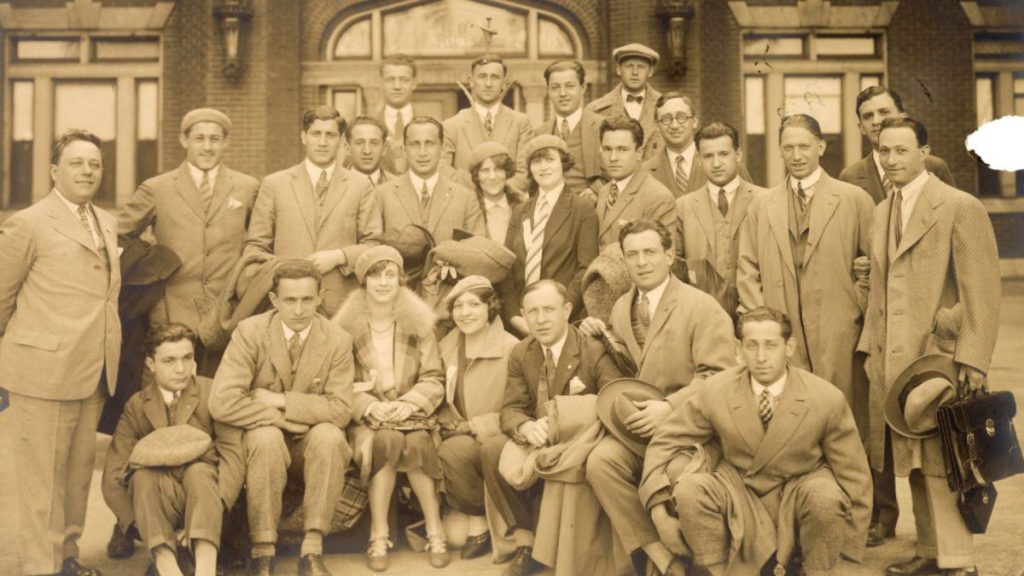
I followed Mrs. Baar down a narrow hallway, past a spotless kitchen and into a modest sitting room. For several hours, she quietly chain smoked while I looked through her photograph albums, an unofficial archive of Hakoah history. Only recently had I realized that the “Austrian football team” my grandfather had boasted of playing for was in fact the Hakoah Vienna Sports Club. Mrs. Baar said she did not remember my grandfather. “Everyone came through our apartment,” she laughed. “Too many to count.”
Finally—there! I followed Mrs. Baar’s long arthritic finger to the script beneath yet another team photo of strapping young men. “Hirsch-Jersonofsky,” she read, and I held my breath as I traced the name to a player in the back row. Tufts of reddish hair stood up from his head. He had my brother’s square chin and broad, planked face. Mrs. Baar translated the German writing: “He was in the first football team. After he returned from the war he did not play.” Many of the people I’d met since that summons in the darkened theater had spoken of “the Hakoah family.” Now I knew why.